Who we are
Signs of Hope is a therapy service for Deaf, Deafblind and Hard of Hearing people or their relatives who would like Deaf-Aware counselling or psychotherapy.
About us
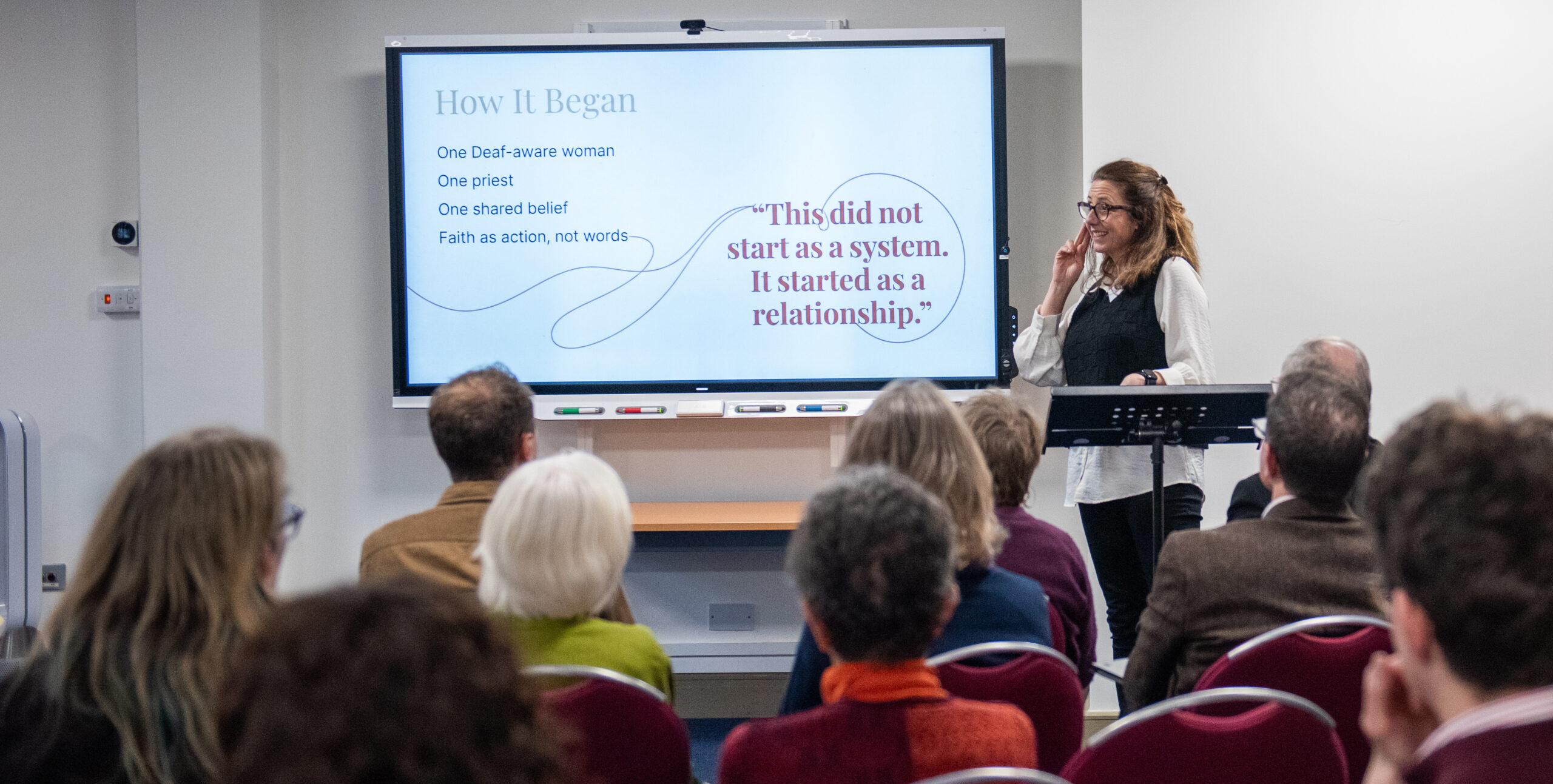
Signs of Hope was one of the first BSL counselling services in the UK, and has been supporting the Deaf Community since 2001. It began as part of Westminster Diocese Deaf Service (now the Caritas Deaf Service) and offered counselling to Deaf people in the Diocese of Westminster.
We are now a service of Caritas Westminster and have grown to offer counselling, psychotherapy and other services in London or online to anyone in the UK.
Who can use Signs of Hope?
Signs of Hope is for people over the age of 18 who are:
- d/Deaf, Deafblind or Hard of Hearing
- CODAS and other relatives of Deaf people who want support that understands Deafness
- Deaf counsellors psychotherapists and other professionals
- Other people who use Sign Language to help them communicate
We welcome people of any racial or cultural background, sexual orientation, and of all faiths and none.
We offer:
Deaf-Aware support
We believe that it is important for Deaf people to have access to counselling and therapy in their own language without needing interpreters. We also believe that Deaf people have a right to therapy that understands the Deaf community, audism and communication deprivation and other issues that affect many Deaf people.
Faith-Aware support
For people who want to have therapy that understands religion and spirituality, we can offer faith-aware therapy.
For some people religion or spirituality is an important part of their lives. Faith-aware therapy offers a safe space to explore your religion or spirituality. This could include positive or negative experiences of religion and spirituality.
Faith-aware therapy can help you to:
- Explore your faith or spirituality or religious issues
- Understand the importance of your religion while supporting you with other issues
- Feel supported if you have experienced spiritual abuse
What are counselling & psychotherapy?
Signs of Hope offers counselling and psychotherapy. They are both ways to support someone through listening in a non-judgmental way to help them deal with their feelings and find ways to cope with life more easily.
Counselling and psychotherapy are very similar but psychotherapy helps you explore your issues at a deeper level. Sometimes we use the word “therapy” to mean either counselling or psychotherapy.
Your therapist cannot tell you what to do, but they can help you explore different options or learn some new coping skills. They can also help you to understand your problems from a different perspective.
Click here for the British Association for Counselling and Psychotherapy
Counselling & Psychotherapy in BSL
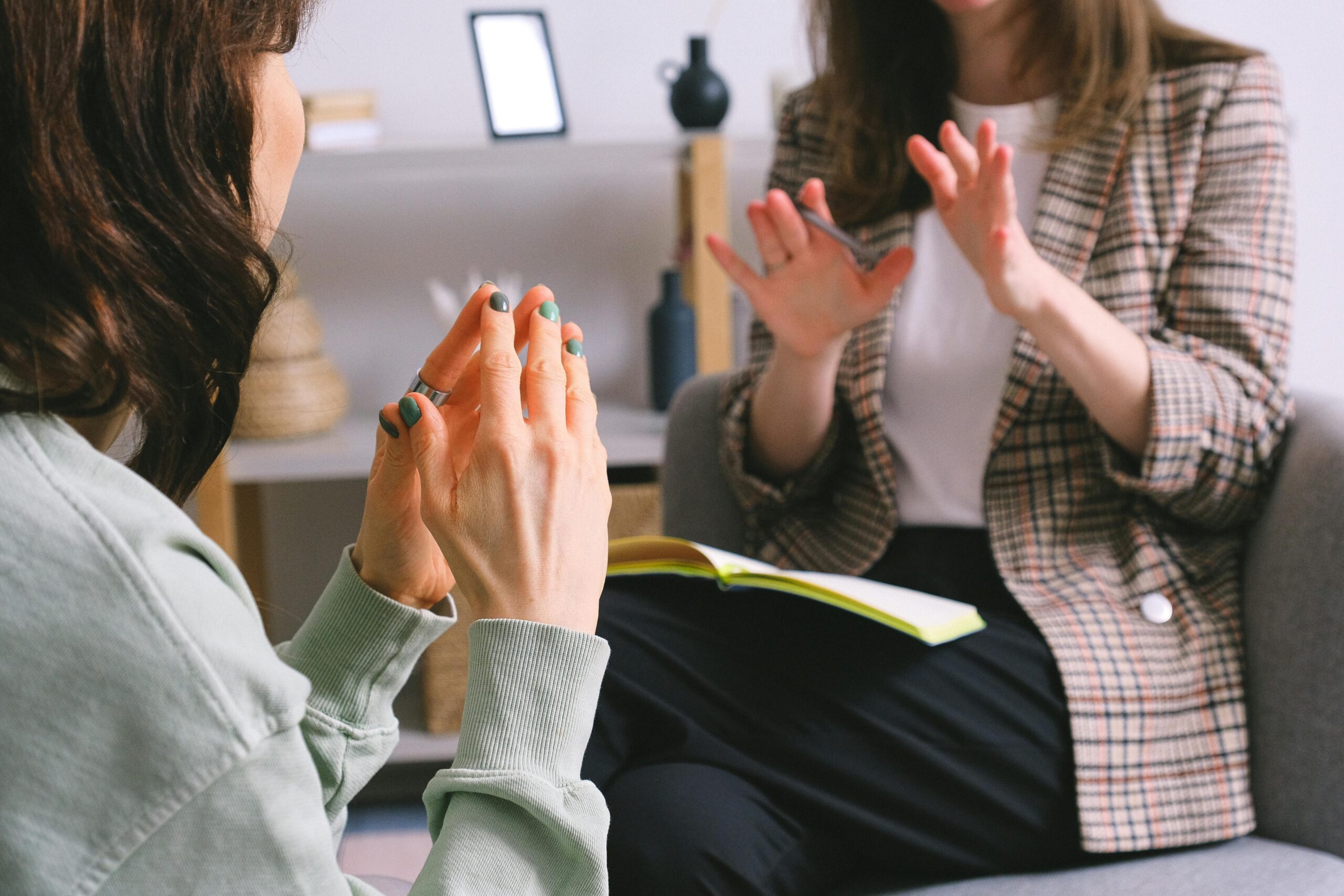
We can offer individual or couples’ therapy in:
- British Sign Language (BSL)
- Sign Supported English (SSE)
- Deafblind Manual Alphabet
- Hands-on or Visual Frame Signing
All our counsellors or psychotherapists are Deaf or fluent in Sign Language, and are fully qualified and accredited by BACP, UKCP or ACC.
How can I get support?
Our waiting list is quite long. If you feel like you might harm yourself or if you are in danger from another person, please tell us on the form so we can place you in our priority waiting list.
When a place is available, you will be invited to meet a therapist for an initial assessment, to make sure that Signs of Hope is the best kind of support for you. In most cases, you will then be able to start regular therapy sessions. If your therapist thinks a different kind of support would suit you better, they will give you more information about how to access this.
Referring someone else for therapy
We prefer clients to contact us themselves using our self-referral form if possible. If you would like to find out about referring someone else, contact signsofhope@rcdow.org.uk.
Domestic Abuse & Spiritual Abuse in the Deaf community
Domestic Abuse is more common in the Deaf Community; Deaf women are twice as likely to experience Domestic Abuse at some point in their lives. For abuse survivors who are religious, it is important that the support they receive understands the role of faith in their lives.
Some domestic abuse perpetrators or other people twist religious rules to force victims to stay with them: this is called spiritual abuse. It is a very powerful way to control someone and it is recognised as a form of Domestic Abuse under British law.
Spiritual abuse can also happen within faith communities, when someone tries to use religion to control or harm you. Spiritual abuse is very serious: it happens in cults, but it can also happen in any religion if someone exploits another person’s beliefs to religion to manipulate or control them. Spiritual abuse can be used with sexual, financial, or other kinds of abuse.
Deaf people can be more vulnerable to spiritual abuse because it is more difficult for them to access information or support.
Signs of Hope offers the following in BSL:
- Domestic abuse counselling
- Domestic abuse counselling that understands faith and spirituality
- Spiritual abuse counselling
Emergency support
If you are experiencing Domestic Abuse and you are in danger, call or text 999. You can also contact Signhealth’s Domestic Abuse service at da@signhealth.org.uk or on 07800 003421 (text only).
BSL Life Skills Programmes
We offer the following BSL “Life Skills” programmes:
- Anger Management
- Advanced Anger Management
- Confidence Building
- Advanced Confidence Building
- Relationship Skills
We can offer these programmes to individuals . Organisations can book us to lead a workshop with groups online or in person.
We have BSL videos for each of these programmes and a video of relaxation exercises. Please contact Signs of Hope to book a Life Skills workshop or for a free link to our Life Skills videos.
Anger Management – learn to understand about different types of anger, understand your own anger, use important skills to help control your anger and deal with other people’s anger.
Anger Management (BSL Support)
Advanced Anger Management (BSL Support)
Confidence Building – learn how to feel good about yourself, be more assertive, ask for what you want and get other people to respect you.
Confidence Building (BSL Support)
Advanced Confidence Building (BSL Support)
Relationship Skills – learn about different kinds of relationships, what is a “good” relationship, how to deal with difficult or abusive relationships and improve your relationship skills.
Instances of mental health issues within the Deaf community are significantly higher than in the general population. Signs of Hope is a counselling service for Deaf, deafened, Hard of Hearing and Deafblind people and their friends and family.
Following some high profile suicides in the Deaf community earlier this year we have produced the video below as a way to help support people in crisis. The video is presented in BSL with an audio track in English and the transcript is included below.
> Transcript
Hello my name is Nikki, I work at Signs of Hope a counselling service for Deaf people. Recently in the Deaf Community there has been a lot of sad news about Deaf people who have died because of suicide and this has especially affected young Deaf men. This is important and you are important. All life is valuable.
Maybe you know someone who has died because of suicide or maybe you are worried about another person who is at risk of suicide or maybe you are in that position yourself. If you have been thinking about suicide or self-harm maybe you have thought that you don’t want to bother other people about it thinking it is better to keep it to myself. That is not the case. It is really important that you talk with somebody that you trust. It could be a friend or a family member or a professional it doesn’t matter who it is but it is really important that you let somebody know how you are feeling. It can be difficult for Deaf people to access support so it important that you know how to access the support that is available for you.
If it is an emergency and you or someone you know is in crisis and wanting to kill themselves then go straight to A&E or text 999. Check that your phone is already registered so that you can use the 999 text service. To register your phone text REGISTER to 999. If you are looking for confidential support from a helpline you can contact the Samaritans by email jo@samaritans.org. Another option is to get support via text message. Text DEAF to 85258. The service is free, you can text day or night and it is confidential. It is not always possible to get a reply straightway and you may have to wait up to 24 hours before you receive a reply.
While you are waiting for some support, if you are feeling really emotional and need to calm down there are some things you can do. Try breathing slowly, count your breathing, as you breathe in count up to 7 and as you breathe out count up to 11. Sit down and press your feet firmly into the ground. With your hands clench them and then release them. Try to go for a walk. Make sure you go to a safe place for example a friend’s house, or a hospital, or a place where you know there will be other people. You may prefer other options. There is an app Stay Alive that you can download onto your phone and it is free. The app can help you in 3 ways, give information about local support, help you to create a safety plan for yourself, and helps you to think about your life. If you are looking for support in sign language you can have counselling or psychotherapy.
At Signs of Hope we offer free counselling. We can offer communication in BSL, SSE or spoken English, the choice is yours. We do not use interpreters as it is much better for you to communicate directly with the counsellor.
Our contact details are Email: signsofhope@rcdow.org.uk or SMS 07534 570429.
If you are thinking of harming yourself or contemplating suicide please let us know so that we can start your counselling quickly.
There are other options as well. There is Deaf4Deaf counselling service, Sign Health, and Deaf people who are private counsellors. If you want more information please contact us.
If you are thinking of harming yourself or are at risk of suicide, please do not suffer alone. Please ask for help. You are an important person and your life is valuable.
If you are worried about another person please pass this information on to them.
Thank you for watching.
If you know anyone who would benefit from this information please pass on the details of this webpage.
Training & clinical supervision for Deaf practitioners
Signs of Hope offers training for Deaf counsellors, psychotherapists, domestic abuse workers and other Deaf professionals. Our training courses include:
- Working with Domestic abuse in counselling and therapy
- Understanding domestic abuse & religion
- Understanding trauma & trauma-informed support
- Working with trauma in counselling & therapy
- Working with internalised abuse & oppression in counselling & therapy
Clinical Supervision
If you are a Deaf counsellor, psychotherapist, or other “helping” professional, contact Signs of Hope to find out about clinical supervision in BSL.
Developing Deaf-Centred Therapy
Deaf-Centred therapy is different from Deaf-Accessible therapy or Deaf-Aware therapy, because the latter two are models of therapy created by and for hearing people, adapted into BSL.
Deaf-Centred therapy is a model of therapy created by and for Deaf people.
Signs of Hope is committed to improving standards of Deaf and Signing counselling and psychotherapy. We have a think-tank of experienced professionals working to develop Deaf-Centred therapy. Get in touch with us if you would like to know more.
Neurodivergence, Trauma & Sign Language
Some hearing people use Sign Language to help them communicate when they have non-verbal shutdowns. People can experience non-verbal shutdowns when they feel overwhelmed, and this can happen more often for some people who are neurodivergent or affected by trauma.
Many people who experience non-verbal shutdown find Sign Language helps them to communicate and cope.
Signs of Hope can offer bilingual BSL/English therapy for hearing people who need to use a mixture of Sign Language and spoken English when they feel overwhelmed.
We are developing workshops to help people who experience non-verbal shutdowns and their loved ones learn to communicate with Sign Language.
Other support available
Counselling & Psychotherapy
Deaf Counselling
Other Support
Royal Association for Deaf People (RAD)
Faith-based support
FAQs
What will I have to talk about?
Your counsellor will ask questions to help you, but you don’t have to talk about anything if you don’t want to.
What if I am not sure if I want to have counselling?
Don’t worry, you can come and talk to an experienced counsellor free of charge to find out more. Then you can decide if counselling is right for you.
How long does counselling last?
Sessions are 50 minutes long, and normally once a week. The number of sessions varies a lot. It is usually between 6 and 20 sessions. You can always stop the counselling at any time if you want to.
Where does counselling take place?
For confidentiality, the counselling does not happen at the main office of Caritas Deaf Service. Counselling usually takes place at a separate site in Islington or remotely using video calling. Your counsellor will give you the details with your appointment.
Contact us
General enquiries: 07534570420
Counselling & psychotherapy: 07936 939522 (text only)
Signs of Hope
Caritas Westminster
Vaughan House
46 Francis Street
London SW1P 1QN