By Anita Tozzi, Justice & Peace Coordinator
The word courage comes from the Latin cor, meaning “heart.”
Inspired by the lives and experiences of people seeking sanctuary, Refugee Week 2026 invites us to explore the theme of Courage.
For refugees around the world, courage is often a daily necessity. It is the courage to face unknown journeys, learn new languages, navigate unfamiliar systems, or simply to wake up each morning and step into an uncertain world.
At a time when some seek to divide and blame, Refugee Week 2026 calls us to come together and share the courage to welcome, to stand for what we believe in, and to celebrate culture and community – to be joyful, imagine new possibilities, dream, heal, and connect.
Courage isn’t always loud or bold. It can be found simple acts in simple acts such as opening your door to a neighbour, trying new food, reading a book, or watching a film that changes your view of the world. It can be speaking up, asking for help, sharing your story – or simply having the courage to be yourself.
Through art, stories, and community, we celebrate the courage that lives within us all – and how connection helps it grow.
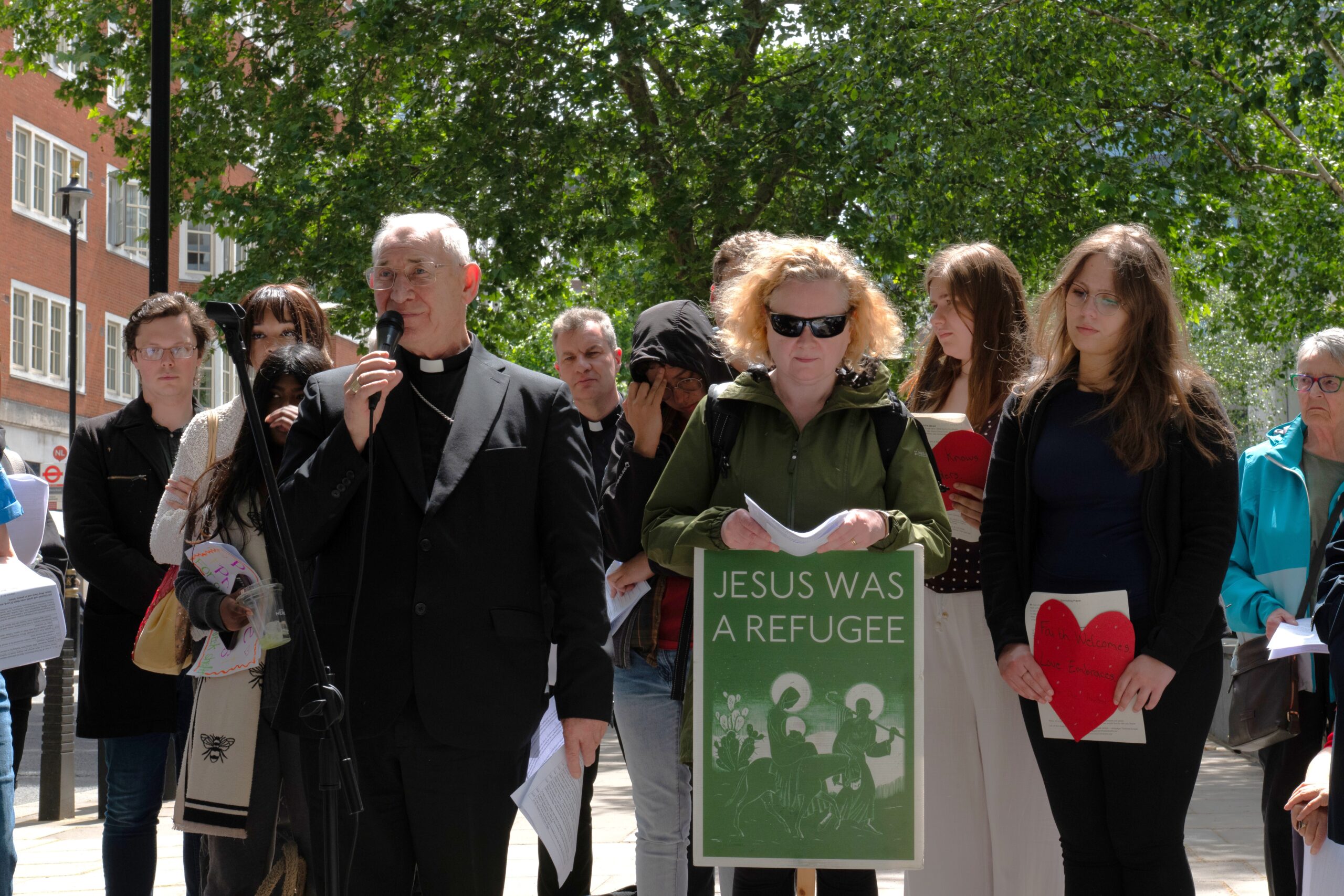
At Caritas Westminster we seek to connect and pray for refugees from around the world who are all part of our human family. This is why it is so important to represent our Catholic faith at the Home Office Vigil in London.
In his recent encyclical Pope Leo XIV asks us to remember the human dignity of all.
“Building a world in which everyone can flourish requires shared responsibility and courage. No one can single-handedly bear the weight of the challenges the world is facing, just as no one is so weak that they cannot play their part, for “power is made perfect in weakness” (Cor 12:9). All are given their own section of the wall: scientists and researchers, entrepreneurs and workers, educators and legislators, civil society, popular movements and faith communities. This is the logic of subsidiarity, which values the cooperation between generations, peoples, disciplines and cultures as the best way for fostering stability, prosperity and peace. We should not be intimidated by tensions or differences because they can become creative forces when guided by shared responsibility.”
“Finally, building for the common good requires an evangelical language. We must avoid humiliating or antagonistic words, opting rather for a clarity that sheds light and a frankness that unlocks new possibilities. We cannot condone naïve enthusiasms, nor fuel unfounded fears. Instead, let us establish standards for discernment – the dignity of the human person, the universal destination of goods, the preferential option for the poor, care for our common home and peace – and let us translate these standards into practices such as responsible planning, the assessment of human and social impact, the inclusion of the most vulnerable, the promotion of digital literacy and guiding research and industry towards justice and peace.”
To sum up, during Refugee Week we are called to be global citizens, to be a voice for those who are voiceless and to represent the most vulnerable of our brothers and sisters. By 2050, one billion people will have become refugees displaced by war, famine or the effects of climate change. Let us take a stand to reverse this trend, let us join forces to create a global community of Care for Our Common Home where the rights of all are respected. And may we hold to account those in our government who seek to diminish the importance of human life and human dignity, regardless of where it comes from. May we have the courage to always defend human life and protect the lives of our global brothers and sisters from around the world.