James Holland, Coordinator of Ecumenism & Westminster Interfaith, reflects on a recent webinar on Interfaith Dialogue as a source of hope in today’s divided world, inspired by the legacy of Blessed Pierre Claverie.
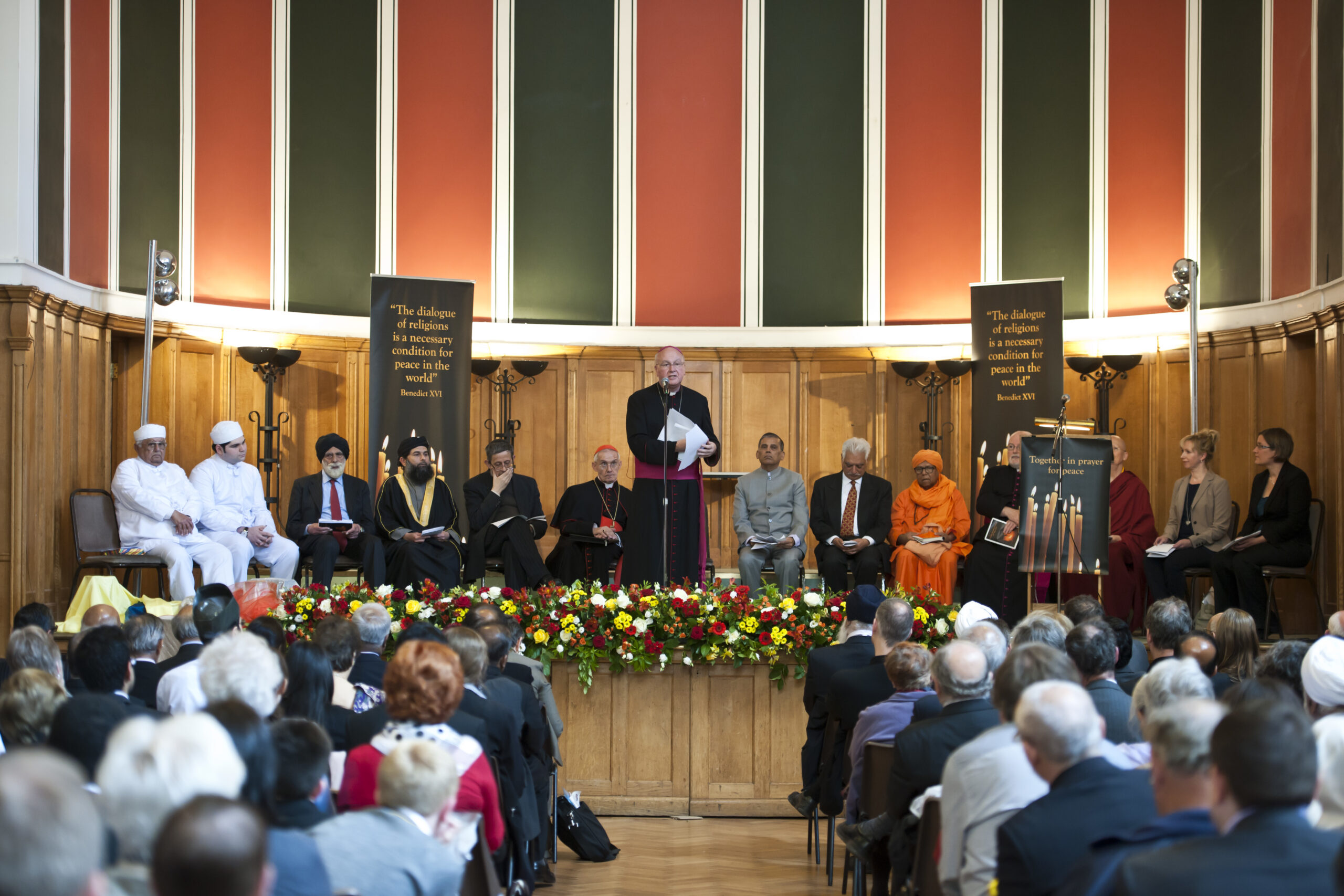
A couple of weeks ago, I had the privilege of speaking to a group of Caritas Parish Representatives about the hope-filled practice of interreligious dialogue in the Church.
The timing of the talk was significant: as the ongoing national conversation around immigration seems to grow increasingly divisive, could dialogue point us towards a better path?
Pope St John Paul II gives us a simple description of dialogue, as ‘not so much an idea to be studied,’ but ‘a way of living in positive relationship with others’ (Meeting God in Friend and Stranger, §2). Interreligious dialogue, therefore, challenges Christians to live in positive relationship with other religions around us.
We might say that dialogue lets us move from a point of opposition to a point of relation; seeing people from other religions not as a threat or a danger to a Christian way of life, in opposition to us, but as people in whom God also dwells, understanding them in relation to us.
In the webinar, we looked at some of the practical ways to dialogue, as set out by the Church. These include a “Dialogue of Life” – living in an open and neighbourly way with those around us – and a “Dialogue of Action;” collaborating with people of other faiths to address common issues in a local community.
Using these ways of dialogue, the Caritas Reps were encouraged to reflect on how they can cultivate a dialogue of life and friendship with local places of worship close to their parish. They were also encouraged to examine where social action in the community can take on a new lease of life, by working with local people of faith on issues that affect us all.
In the second part of the webinar, I gave an account of the life of Blessed Pierre Claverie, someone who cultivated a dialogue of friendship with the Muslim population in Algeria during the Algerian Civil War.
In a time when being a high-profile Catholic was incredibly dangerous, Blessed Pierre, as the Bishop of Oran, continued to preach that
the Church must always be at the foot of the Cross, sharing the suffering of the most abandoned: ‘For here it is really a question of love, love first of all and love alone. A passion for which Jesus has given us the taste and shown the way: “There is no greater love than to lay down one’s life for those whom one loves”.’ 1
Blessed Pierre’s belief that the Church must always share the suffering of the most abandoned compelled him to stay in Algeria.
As Bishop of Oran, Pierre made friends with a Muslim man named Mohamed Bouchikhi. Mohamed had grown up living next to a church, and when his own father evicted the family from their home, the priest next door gave them refuge for a year. In the summer of 1996, the handyman at the Bishop’s residence was away, and so Mohamed kindly volunteered to drive Bishop Pierre to his appointments and help over the summer.
On the evening of 1 August 1996, Bishop Pierre was met at an airport by Mohamed and a police escort. They arrived at the place they were travelling to and, as they stepped over the threshold, there was a powerful explosion. Both were killed instantly.
Blessed Pierre is remembered as a martyr, someone who knew he would face death because of his choice to stay with the Algerian people. He will also be remembered as someone who viewed dialogue — most simply expressed as friendship and building positive relationships — as an essential part of being a Catholic, particularly when living among people of different religions. Most of all, he will be remembered as someone whose life, lived in dialogue, was a witness to the sacrificial, all-encompassing love of Christ.
To mark the beatification of the 19 Algerian Martyrs who were killed during the Civil War, an icon was commissioned. In the bottom right-hand corner of the icon, there stands another person. He’s dressed in normal clothes, though curiously for an icon he does not have a halo, and he points towards the minaret of a mosque. This is Mohamed Bouchikhi; a Muslim man, remembered in a Christian icon, as someone who, out of love, gave his life for his friends.
For me, the example of Blessed Pierre and Mohamed is an antidote to so much of the division we see in the world today. And while martyrdom was the courageous conclusion to their lives, it did not mark the end of their influence. They leave behind a powerful example of dialogue and friendship; witnessing that religions are not destined to live at enmity with one other, but that the path of interfaith dialogue can truly be a journey into hope.
Read more about the Algerian Martyrs and the icon commissioned to commemorate them here: https://www.plough.com/en/topics/faith/witness/the-martyr-in-street-clothes.
To find out more about the work of Westminster Interfaith and our upcoming series, “A Journey into Hope,” visit https://rcdow.org.uk/interfaith/ or email westminsterinterfaith@rcdow.org.uk.
- The Certainty of Being Loved, McGee, pp.200-201 ↩︎